
That Slow Drain Isn’t Always a Clog, Sometimes It’s the Beginning of a Much Bigger Problem
Cast iron pipes were built to last. And for a long time, they did. Most homes and commercial buildings constructed before the 1970s still have original cast iron drain systems running through their walls, under their floors, and connecting to the municipal sewer. For decades, those pipes did exactly what they were supposed to. But cast iron has a lifespan and a lot of that original pipe is now past it. Full Cast Iron Piping Replacement is one of the more significant plumbing investments a property owner can face, and most don’t see it coming until something has already gone wrong.
This post is about recognising the signs before the failure, understanding what replacement actually costs and involves, and making an informed decision about whether to replace in sections or tackle the whole system at once. Because that last question partial vs. full is where most people get the answer wrong the first time. No fluff here. Just the practical information that helps a homeowner or property manager make a decision that’s going to cost real money either way and costs significantly more when it’s made reactively instead of proactively.
What Actually Happens to Cast Iron Over Time
Cast iron corrodes. That’s the short version. The longer version is that cast iron drain pipes corrode from the inside out meaning the degradation is invisible until it’s advanced. Hydrogen sulfide gas produced by organic material in wastewater reacts with moisture on the pipe interior to form sulfuric acid. That acid attacks the iron. Over decades, it creates pitting, scaling, and eventually structural failure.
The pipe lifespan cast iron manufacturers originally claimed was 50 to 100 years under ideal conditions. The operative phrase is “ideal conditions.” Pipes under concrete slabs deal with soil movement and moisture. Pipes in exterior walls in cold climates deal with thermal cycling. Pipes in commercial buildings handle far higher flow volumes than they were sometimes sized for. Actual real-world performance runs considerably shorter than the theoretical maximum. By the time a building reaches 50 to 60 years old with original cast iron drain systems, the pipes are somewhere on the degradation curve, maybe early, maybe advanced. A camera inspection is the only way to know where. Looking at the outside of the pipe from an access point tells almost nothing. The failure is on the inside. After all, that’s the point, if the deterioration were visible, it would’ve been caught years earlier.
Warning Signs the System Is Failing
Corroded pipe issues don’t announce themselves with a dramatic failure most of the time. They accumulate quietly. The symptoms that appear at the surface are usually lagging behind the actual condition of the pipe by months or years.
Signs that cast iron drain systems are reaching the end of their service life:
- Persistent slow drains throughout the house. One slow drain is usually a local blockage. Multiple slow drains kitchen, main bathroom, laundry simultaneously suggest a problem in the main stack or building drain, not individual fixture clogs. Snaking relieves it temporarily. It comes back. That pattern is a red flag.
- Recurring drain backups. Especially ground-floor or basement fixtures backing up while upper floors seem fine. This points to partial blockage or collapse in the building drain or sewer lateral. Hydrojetting clears it. Three months later it’s back. The jetting isn’t the problem, the pipe condition is.
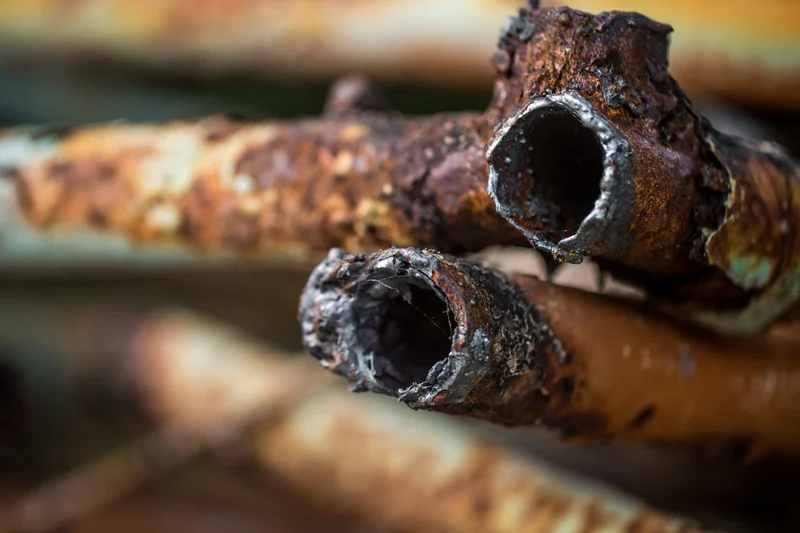
- Visible rust staining or pipe damage at accessible sections. Any cast iron pipe that can be seen in an unfinished basement, in a utility room, that shows surface rust, flaking, visible holes, or wet spots around joints is showing external signs of a system that’s failing internally. If the visible sections look like this, the sections inside the walls likely look worse.
- Odours. Sewer gas smell inside the building. Cast iron pipe that’s developed cracks or joint failures allows sewer gas to escape before it reaches the vent stack. If the smell is intermittent and can’t be traced to a fixture trap, the pipe itself is the likely source.
- Unexplained foundation or slab moisture. A sewer line replacement project often gets identified first through moisture problems, wet concrete, efflorescence, or soft spots in flooring above or adjacent to underground drain lines. These aren’t always plumbing, but they’re worth a camera inspection before assuming a different cause. Truth be told, the symptom that finally prompts action is rarely the first symptom. Most of these signs have been present for a while before anyone connects them.
Camera Inspection: The Only Honest Diagnosis
There’s no responsible way to assess cast iron pipe condition without a camera inspection. A plumber who quotes old pipe replacement without running a camera through the system is either guessing or overselling. And a plumber who dismisses the concern without looking inside the pipe is missing the point.
A drain camera inspection runs a flexible camera through the pipe from a cleanout or access point and records what it finds. What it’s looking for in aging cast iron:
- Active corrosion — pitting, scaling, visible rust tubercles reducing the internal diameter
- Joint failures — cast iron pipes were joined with lead and oakum packing, which degrades over time; failed joints allow root intrusion and ground infiltration
- Root intrusion — tree roots find any small opening; once inside a pipe they expand and eventually cause collapse
- Partial or full collapse — sections of pipe that have failed structurally, restricting or blocking flow
- Offset joints — soil movement has shifted pipe sections out of alignment, creating steps where solids catch and accumulate
A good camera inspection produces a recording and a written report with footage timestamps and findings by location. That documentation drives the replacement scope and it protects the property owner from a contractor who recommends replacing more than what’s actually failing.
Get the recording. Review it. Ask the plumber to walk through what they’re seeing. Any contractor who hesitates to explain their own camera footage is worth a second opinion.
Partial vs. Full Replacement: Getting the Decision Right
Full Cast Iron Piping Replacement versus a targeted section replacement is the decision most property owners struggle with. And the honest answer is: it depends on what the camera shows. Not on what’s cheapest today. On what’s actually in the pipes.
The argument for full replacement when the system is 60-plus years old:
- If one section is failing, adjacent sections are made of the same pipe, the same age, exposed to the same conditions. They’re on the same degradation curve maybe six months behind, maybe two years.
- Partial replacement means opening walls and floors for a second time when the next section fails. The labour cost of access often exceeds the material cost of the pipe itself.
- A full system replacement done properly produces documentation, updated inspection records, and a system with a known service life which matters significantly at resale.
- Financing a full replacement is possible. Financing emergency repairs after a second or third partial failure is the same cost without the planning benefit.
The argument for staged replacement, when it’s actually valid:
- Camera inspection shows clearly that specific sections are failing while others remain in adequate condition not just older, but actually documented as functional
- The building is undergoing a phased renovation anyway and plumbing access will be available in the remaining sections during later phases
- A short remaining ownership horizon makes the long-term ROI of full replacement less applicable
A plumbing system upgrade planned and executed all at once is almost always more cost-efficient than the same work done in three separate emergency calls over five years. The camera footage makes the case. Let it.
What Full Cast Iron Pipe Replacement Actually Costs
Honest numbers. Cast iron pipe replacement cost varies significantly based on access, scope, building type, and whether the drain lines are above-slab, under-slab, or buried in the yard. Here’s what the range looks like in the Ottawa market:
- Above-slab stack replacement (main 3″ or 4″ stack, accessible through drywall): $3,000 – $8,000 depending on height and number of branch connections
- Under-slab building drain replacement (excavation required inside the building): $8,000 – $20,000 depending on footage and access complexity
- Sewer lateral replacement (from the house to the municipal connection at the property line): $6,000 – $18,000 depending on depth, length, surface restoration, and whether excavation or trenchless methods are used
- Full system replacement (stack, building drain, lateral): $15,000 – $40,000+ for a typical residential property
- Trenchless pipe lining as an alternative where applicable: $80 – $250 per linear foot installed, often comparable to or less than open-cut replacement when surface restoration is factored in
What drives the cost toward the high end: concrete cutting and restoration, landscaping or driveway restoration above buried lines, significant depth at the sewer connection, heritage or finished interior surfaces that limit access options.
According to the Canadian Home Builders’ Association, water and sewer-related damage is consistently among the top insurance claim categories for Canadian property owners. Proactive sewer line replacement before failure is substantially cheaper than emergency excavation plus damage remediation in most cases by a factor of two to three.
What Replaces Cast Iron and Why the Material Choice Matters
The standard replacement material for residential and light commercial drain systems today is either PVC or ABS, both plastic pipe systems that don’t corrode, don’t rust, and don’t react with the hydrogen sulfide environment that destroys cast iron over time.
- PVC (polyvinyl chloride) is the more common choice for drain-waste-vent systems in new and replacement plumbing. It’s smooth-walled which means better flow characteristics and less opportunity for buildup compared to deteriorated cast iron. Properly supported and installed, PVC drain systems have a theoretical lifespan well beyond 100 years.
- ABS (acrylonitrile butadiene styrene) was the default through much of the 1970s and 1980s which means a lot of buildings that had their cast iron replaced in that era now have ABS that’s approaching its own end of life. ABS is less impact-resistant than PVC and has shown a higher rate of joint failure as it ages. Worth knowing when assessing an old pipe replacement situation in a building that’s had prior plumbing work.
For trenchless applications where existing pipe is relined rather than excavated, cured-in-place pipe lining (CIPP) creates an epoxy or resin liner inside the existing cast iron that is structurally independent of the host pipe. When properly installed, the liner restores flow capacity, seals joint failures and root entry points, and has its own service life of 50-plus years. The material choice should follow the specific conditions of the project access constraints, existing pipe diameter, and the nature of the failure. A plumber who recommends the same solution for every cast iron replacement job isn’t applying enough judgment to the problem.
Frequently Asked Questions
What are the signs of failing cast iron pipes?
Recurring slow drains across multiple fixtures, repeated drain backups that return after snaking, sewer gas odour inside the building, visible rust or flaking on accessible pipe sections, and unexplained moisture near floor drains or at slab level. Any one of these warrants a camera inspection. Multiple symptoms together suggest a system that's in advanced decline and needs professional assessment promptly.
How much does cast iron pipe replacement cost?
Above-slab stack replacement runs $3,000–$8,000. Under-slab building drain replacement typically costs $8,000–$20,000. Sewer lateral replacement from the house to the property line runs $6,000–$18,000. A full system replacement on a typical residential property ranges from $15,000–$40,000 or more depending on access complexity, depth, and surface restoration required above buried lines.
Should I replace all cast iron pipes at once?
In most cases, yes when camera inspection shows the system is in advanced decline. Adjacent sections of the same age fail on similar timelines, and partial replacement means reopening walls and floors again within a few years. The labour cost of access often exceeds material cost, making full replacement more economical than staged repairs across multiple mobilisations. A camera inspection identifies whether staged replacement is genuinely justified.